

Who is Eduadro mutuc?


He is a Filipino metalsmith and sculptor who has dedicated his life to creating secular and religious pieces using silver, wood, and bronze. He was conferred the prestigious Gawad ng Manlilikha ng Bayan in 2004 for preserving the traditional art of “pinukpuk” or metal craft and becoming one of the most respected creators of religious and secular art today.

The Birth of a Metalsmith
Eduardo Mutuc, also known as “Tatang Eddie” is a Kapampangan from Apalit, Pampanga born on October 12, 1949. He came from humble beginnings, raised by parents who were farmers and grew up with nine other siblings in the family. He began helping his family on their farm right after his elementary graduation, but he never reached high school after that.
His talents in sculpture and metalwork were discovered quite late. He started as an apprentice to an antique shop business. It was in this stint that he learned the rudiments of wood carving and later ventured into the metal craft locally called as “pinukpuk”.
At age 29, he pursued woodcarving as it is a relatively more secure job in addition to his income from farming. It was difficult for Mutuc to learn a profession that he had no prior knowledge of, but this did not stop him from expanding his knowledge and experience―and eventually becoming one of the National Living Treasures.

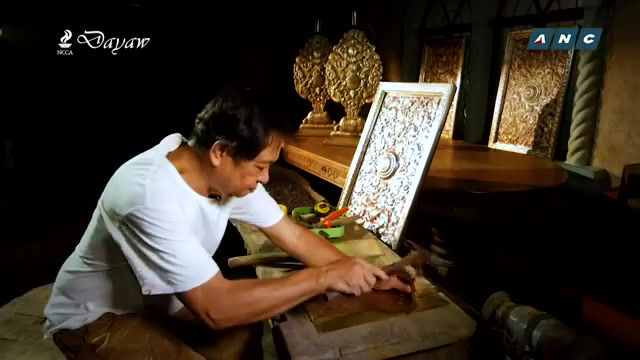
Things began to change for Mutuc when a colleague taught him the art of silver plating which is a technique often used to emulate gold and silver leaf in the decoration of saints and religious screens found in churches. His commission with Monsignor Fidelis Limcauco, who asked him to create a tabernacle for the parish of Fairview, paved the way for other clients seeking him to create other pieces.

At first, Mutuc became an expert at copying existing patterns but as years progressed he became increasingly skilled at infusing designs of his own and traditional religious designs into his work. While he finds meaning in making pieces for the church, orders for commissioned pieces have become fewer because of the economic slump. But even for his secular pieces, he finds inspiration in church art